
Snow Day Predictor Canada — Will School Be Closed Tomorrow?
Check the real-time chance that school will be closed or buses cancelled in your area. Enter your Canadian city or postal code to get an instant snow day probability built from live weather and past closure patterns.
What Is a Snow Day Predictor?
A snow day predictor is a free tool that estimates the chance your school will close because of snow, ice, or extreme cold. SnowDayCA combines live Canadian weather with how local school boards have acted in past storms to give you a clear percentage before any official announcement.
Every winter, parents, students, teachers, and bus drivers ask the same question the night before a storm: will there be school tomorrow? Instead of waiting for a 6 a.m. phone call, you can check your odds early. SnowDayCA is made specifically for Canada, so it understands metric units, Canadian postal codes, and the way provincial school boards make closure and bus-cancellation calls.
How Does the Snow Day Predictor Work?
The predictor pulls live weather for your location, compares it against the conditions that caused past school closures in your region, and turns the result into a single probability score from 0 to 100 percent.
1. Live Weather Data
We read current temperature, snowfall, wind chill, and precipitation for your exact city or postal code and refresh it as a storm develops.
2. Past Closure Patterns
A city with heavy lake-effect snow closes at different totals than a milder region. The model weighs your area’s history, not a one-size-fits-all number.
3. Probability Score
You get one clear percentage. A higher score means today’s conditions look a lot like past days when schools actually closed.
Want the full method? Read our guide on how closure probability is calculated for today and tomorrow, or see how the popular AccuWeather snow day calculator works and how accurate it is.
Why Freezing Rain Matters More Than Snow Totals
A common mistake is judging snow day odds by centimetres alone. School boards weigh timing, ice, and wind together, not just snowfall totals. A few centimetres of freezing rain can shut down buses faster than a much larger snowfall, because ice coats roads and sidewalks and takes longer to clear than snow.
Location changes the picture too. Lake-effect snow near Georgian Bay can produce heavy totals for the Simcoe County District School Board while nearby regions see far less. The Toronto District School Board manages mostly cleared urban roads, so its closure threshold often looks different from a board with longer rural routes. The same forecast can mean a snow day for one board and a normal Tuesday for another.
How Accurate Is the Snow Day Predictor?
Accuracy is highest in the 12 to 24 hours before a storm, when overnight weather is easier to forecast. Longer-range checks are useful for planning but carry more uncertainty. The score is a planning estimate, not an official closure notice.
Real closure decisions also depend on road conditions, bus-driver reports, and staffing that no weather score can fully see. That is why we always tell you to confirm with your school board before making firm plans. Curious how the tools stack up? Compare them in our breakdown of SnowDayCA vs SnowDayPredictor for 2026.
Snow Day vs Bus Cancellation: What Is the Difference?
A snow day means the school itself is closed and no one attends. A bus cancellation means buses do not run, but the school stays open for students who can get there another way. Bus cancellations are far more common than full closures.
❄️ Snow Day (Closure)
School is shut for everyone. This is the less common outcome during a typical Canadian winter storm.
🚌 Bus Cancellation
School stays open, but bus students are excused. This is the most frequent result of a moderate storm.
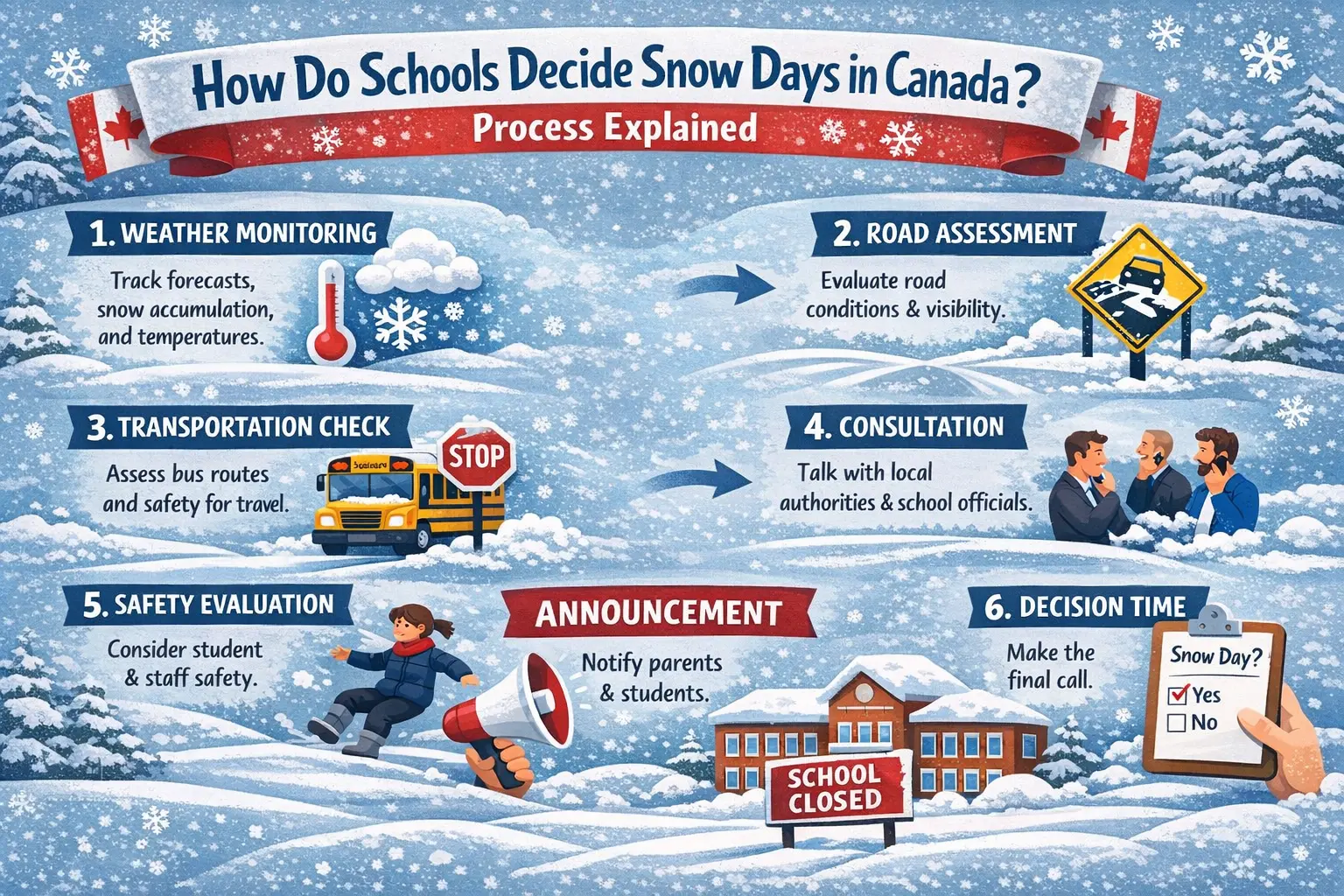
🏫 How Boards Decide
See the full process in how schools decide snow days in Canada.
Snow Day Forecasts by Province and City
Winter is very different across Canada, so we build detailed local pages with regional school-board context and storm patterns.
Snow Day Predictor App, Map, and Calculator Options
You can check your snow day odds right here on the web with no download, or use a dedicated app for alerts. Both use the same core idea: live weather plus your district’s history.
If you prefer alerts on your phone, we compare the top choices in our roundup of the best snow day predictor apps for Canada across iOS, Android, and web. Prefer a browser tool? The live forecast at the top of this page works on any device, instantly and free.
Winter Safety and Snow Day Resources
A snow day is about more than a day off. These guides help families stay safe, warm, and productive when winter weather hits.
🚗 Driving in Snow
How much snow makes driving dangerous and when to stay home.
🚌 Bus Safety
School bus safety tips for snowstorms for parents and students.
🧤 Winter Health for Kids
Essential winter health tips to keep kids safe and warm.
🩺 Shoveling Safety
Is shoveling snow dangerous? Risks, causes, and how to stay safe.
🎒 Snow Days & Learning
💻 Snow Day vs Remote
Snow days vs remote learning: what teachers actually prefer.
🎨 Stay Productive
7 simple ways to stay productive during a snow day.
Why You Can Trust SnowDayCA
Canada-first and transparent. SnowDayCA was built only for Canadian winters. We use metric units, Canadian postal codes, and real provincial school-board behaviour instead of generic global numbers.
Live, sourced weather. Our forecast reads current conditions from professional weather data so your score reflects the storm as it actually develops, not a stale estimate.
Honest about limits. We clearly state that we are a planning aid, not an official source. Final closure and bus decisions always rest with your local school board. Read our full disclaimer and about page to learn how the tool is built, or contact us with questions.