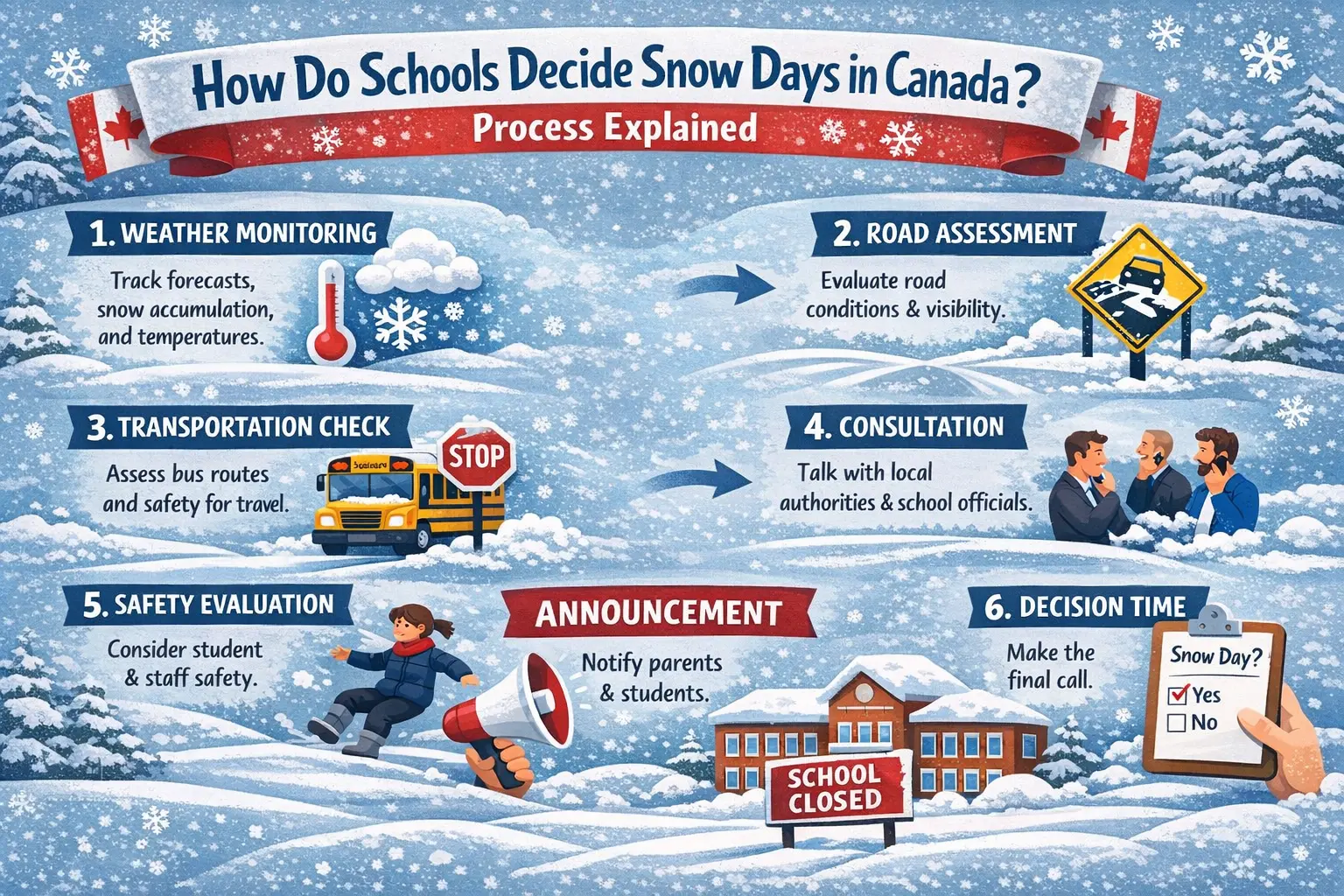
How Do Schools Decide Snow Days in Canada Process Explained
When winter intensifies across Canada, one question dominates conversations among students, parents, and educators: how do schools decide snow days?
At first glance, the decision may appear arbitrary; some schools close while others remain operational despite similar weather conditions. However, the reality is far more systematic and nuanced.
In this comprehensive guide, we will deconstruct the entire snow day decision-making process in Canada, outlining the institutional framework, environmental variables, and logistical considerations that influence whether schools close or stay open.
Check your chances using the snow day calculator.
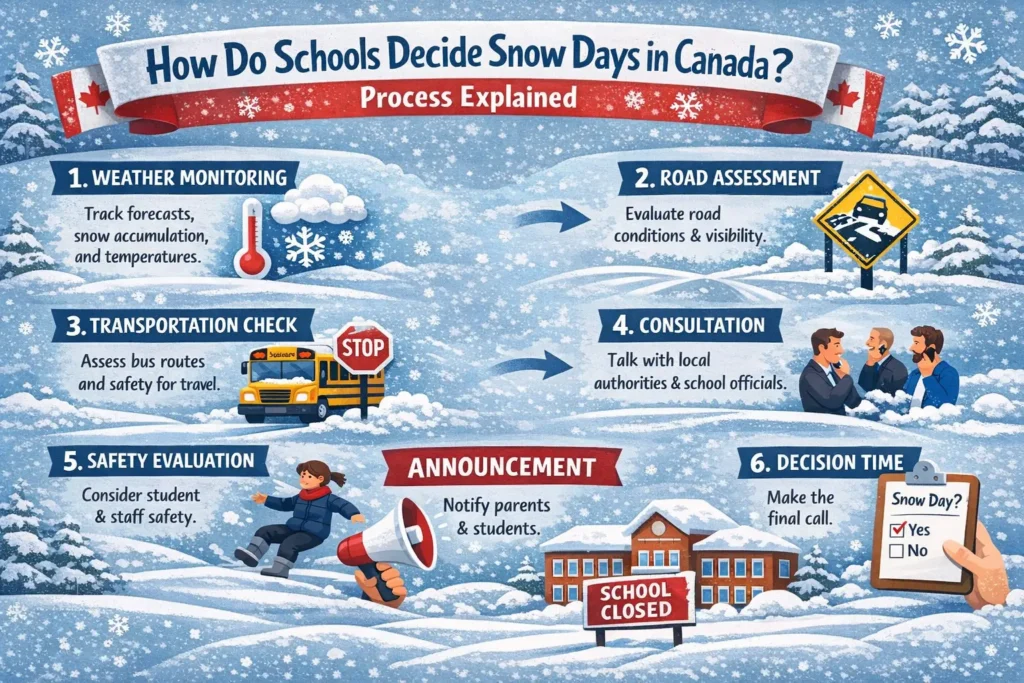
Who Actually Decides a Snow Day in Canada?
Contrary to popular belief, snow days are not determined by individual schools or principals. Instead, the responsibility lies with:
- School boards (district authorities)
- Superintendents
- Transportation departments
These stakeholders collaborate to evaluate conditions across an entire region. In large provinces such as Ontario or Alberta, this often involves coordinating decisions across multiple municipalities.
This centralized structure ensures:
- Consistency in decision-making
- Alignment with transportation logistics
- Region-wide student safety
In essence, a snow day is a collective administrative determination, not a spontaneous choice.
What Factors Do Schools Consider Before Declaring a Snow Day?
The decision to close schools is based on a multifactor assessment rather than a single factor, such as snowfall. Below are the most critical determinants:
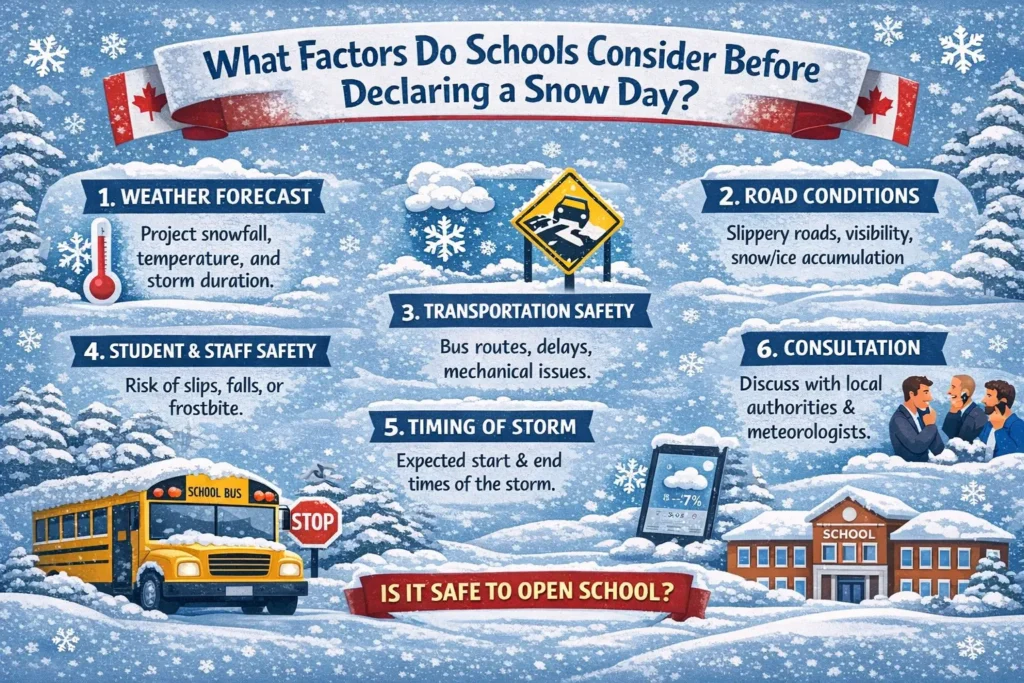
1. Snowfall Accumulation and Timing
While snowfall is an obvious factor, decision-makers evaluate:
- Total accumulation (cm/inches)
- Rate of snowfall
- Timing (overnight vs early morning)
For instance, heavy overnight snowfall can allow municipalities to clear roads before school hours, whereas early-morning snowstorms can create hazardous commuting conditions.
2. Road Conditions and Transportation Safety
This is arguably the most influential factor in Canada.
School boards prioritize:
- Bus route safety (especially in rural areas)
- Road visibility
- Ice formation and black ice risks
If school buses cannot operate safely, a closure becomes highly probable—even if snowfall appears moderate.
3. Temperature and Wind Chill
Extreme cold is a decisive variable, particularly in provinces with severe winters.
Authorities assess:
- Wind chill levels
- Frostbite risk for students waiting outdoors
- Exposure duration during transit
Even in the absence of snowfall, dangerously low temperatures alone can trigger closures.
4. Weather Forecast Reliability
Forecast accuracy plays a critical role. Decision-makers rely on:
- Meteorological predictions
- Real-time weather updates
- Probability of escalation
In situations where forecasts are uncertain, schools may delay decisions until early morning to ensure accuracy.
School boards rely on accurate forecasts from official sources such as Environment and Climate Change Canada to assess storm severity and timing.
5. School Infrastructure and Operational Safety
Beyond weather, internal conditions are also evaluated:
- Heating system functionality
- Power outages
- Accessibility of school premises
A school may close even with mild weather if the infrastructure cannot support safe operations. According to reports from CBC News, school boards coordinate closely with transportation departments before announcing closures.
Why Do Some Schools Close While Others Stay Open?
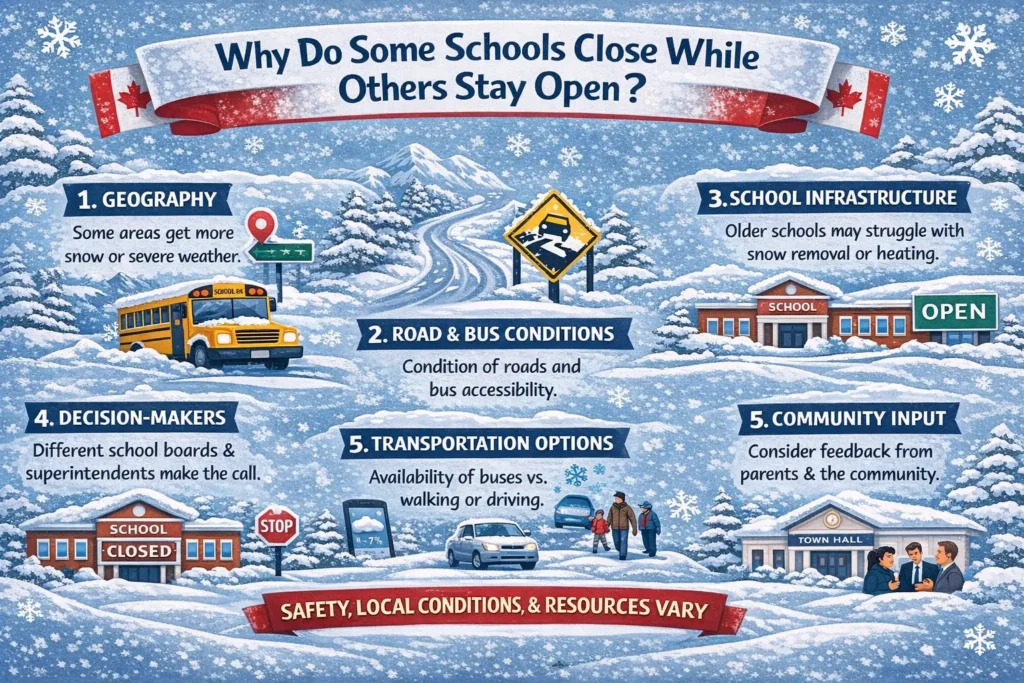
This is one of the most frequently asked—and misunderstood—questions.
The apparent inconsistency arises due to several variables:
Different School Boards
Each board operates independently and may apply distinct safety thresholds.
Microclimates
Weather conditions can vary significantly within short distances. One region may experience severe snowfall, while another remains relatively unaffected.
Transportation Differences
Urban areas often have:
- Better road maintenance
- Shorter commuting distances
In contrast, rural regions face:
- Longer bus routes
- Poorer road conditions
Risk Assessment Variability
Some boards adopt a more conservative stance, prioritizing precaution, while others may tolerate moderate risk.
This explains why two neighboring schools may arrive at different decisions under similar weather conditions.
What Time Are Snow Day Decisions Usually Made?
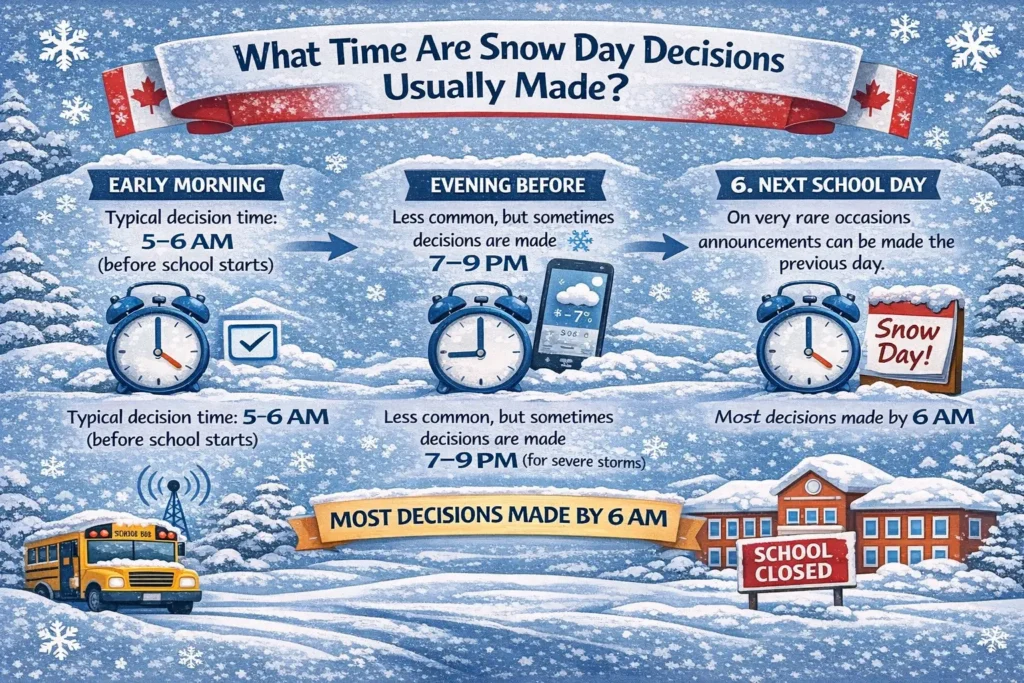
Most school boards in Canada announce closures early in the morning, typically between:
- 5:00 AM – 6:30 AM
This timing allows authorities to:
- Analyze overnight developments
- Incorporate updated forecasts
- Assess road clearing progress.
In rare cases, decisions may be announced the night before if a major storm is highly predictable.
How Are Snow Day Announcements Communicated?
Schools utilize multiple communication channels to ensure timely dissemination:
- Official school board websites
- Email and SMS notification systems
- Local news networks
- Social media platforms
Parents are strongly advised to subscribe to school alert systems for immediate updates.
Are Snow Days Still Common in Canada?
The prevalence of snow days has evolved in recent years.
With the rise of remote learning infrastructure, some school boards now opt for:
- Online classes instead of closures
- Hybrid learning models during severe weather
However, in cases of:
- Power outages
- Internet disruptions
- Extreme safety risks
Traditional snow days remain unavoidable.
The shift toward virtual classes has changed how closures are handled. Explore the full comparison in our guide on snow days vs remote learning.
Can You Predict a Snow Day?
While no prediction is infallible, you can significantly improve your accuracy by analyzing:
- Weather forecasts (snowfall + temperature)
- Historical closure patterns
- Local school board behavior
To simplify this process, you can use a dedicated prediction tool.
👉 Check your chances using the snow day calculator on Snowdayca.com to estimate the likelihood of a closure based on real-time data.
Why Schools Sometimes Stay Open Despite Heavy Snow
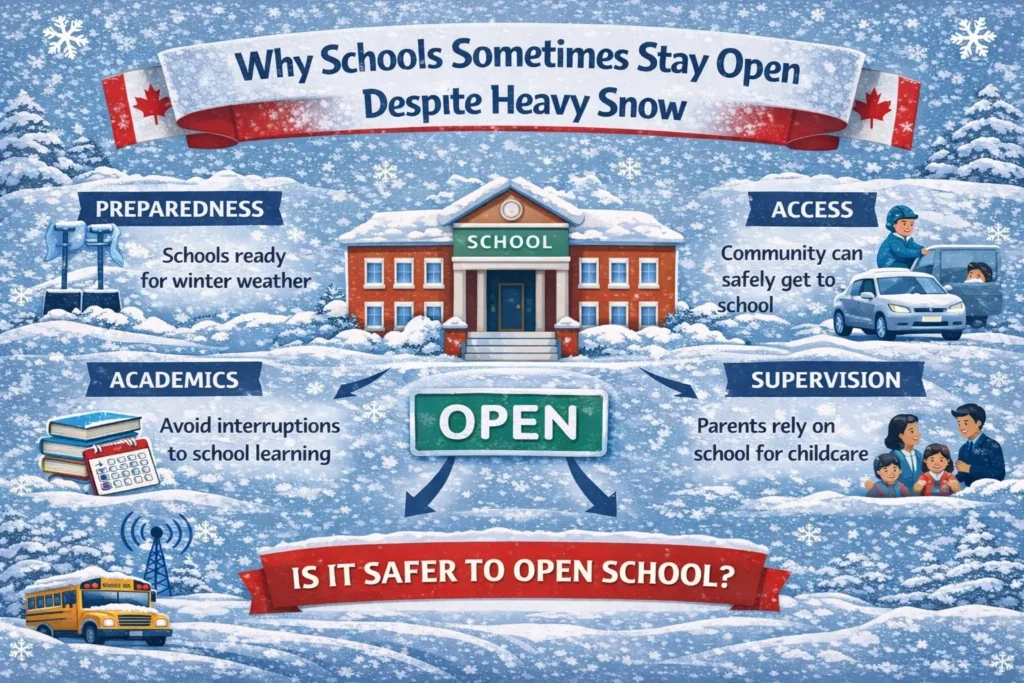
This is a common frustration among students and parents.
The reasoning often includes:
- Roads are still operational despite snowfall.
- Snow removal services are active and effective.
- Conditions are expected to improve during the day.
- Closure thresholds have not been met.
In other words, snow visibility does not necessarily indicate unsafe conditions.
FAQs
Who makes the final decision for a snow day?
School boards and superintendents make the final decision, often in coordination with transportation and safety officials.
How cold does it have to be for schools to cancel in Canada?
There is no universal threshold, but extreme wind chills (e.g., below -35°C to -40°C) often lead to closures due to frostbite risk.
How much snow causes a snow day?
It depends on multiple factors, including timing, road conditions, and regional infrastructure. There is no fixed snowfall amount.
Why don’t schools close even when it’s snowing heavily?
If roads remain safe and transportation systems can operate, schools may stay open despite visible snowfall.
Final Thoughts
Understanding how do schools decide snow days in Canada requires recognizing the complex interplay between weather conditions, transportation logistics, and administrative judgment.
Rather than relying on a single factor, such as snowfall, school boards conduct a comprehensive risk assessment to prioritize student safety while maintaining educational continuity.
For those looking to stay ahead, combining weather awareness with predictive tools can provide a clearer expectation.
👉 Use the Snowdayca snow day calculator to anticipate closures and make informed decisions during the winter season.