What Does a 70% Snow Day Chance Mean?

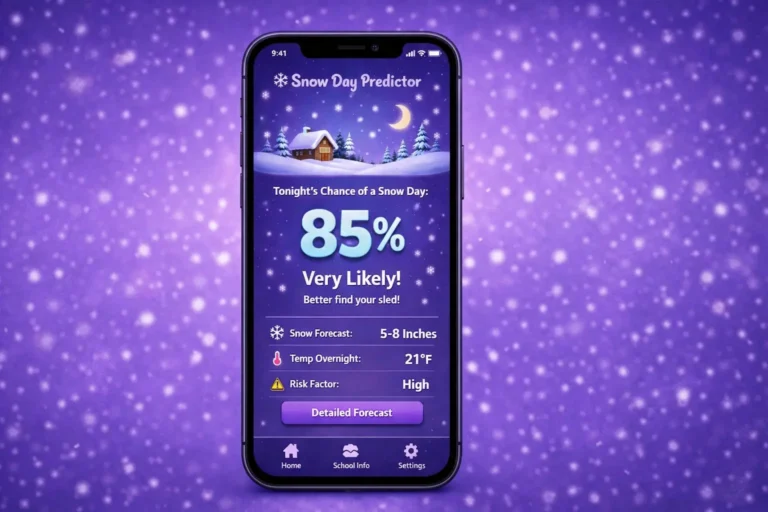
A 70% snow day chance means the forecast is showing a strong mix of snow, cold, and wind — the kind of weather that often shuts schools down. On SnowDayCA, 70% sits in the High chance band. It does not mean schools closed 7 times out of 10 in past storms like this one, and it does not promise a closure. The score reads the weather. Your school board still makes the final call.
You check the forecast the night before, see 70%, and the house starts planning a day off. Then a fair question lands: what does that number actually stand for?
No page on this site has answered it properly until now. The city pages show the score. This guide explains it — what the number measures, how it is built, how it differs from the “chance of snow” in a weather app, and what to do with each score you might see.
What a Snow Day Chance Actually Measures
A snow day chance is a score for disruption, not a count of past storms.
SnowDayCA builds the number from tomorrow’s forecast for your city, using open weather data from Open-Meteo. Four things go in: how much snow is expected, how strong the wind gusts are, how cold the night gets, and whether snow is actually in the forecast. The stronger that mix, the higher the score.
Three things the number is not:
- Not a history score. It is not worked out from a list of past school closures. A 70% score has never counted old snow days.
- Not a machine learning guess. There is no hidden model learning from your board’s habits. The recipe is fixed, public, and set out in full below.
- Not the board’s decision. Boards do not use percentages at all. They judge road conditions early in the morning and announce by about 6 a.m.
Think of the score as a weather reading with a school lens on it: if the forecast holds, how rough does tomorrow morning look for buses, roads, and the trip to school?
The Four Bands: Where 70% Sits
Every score falls into one of four bands. These are the same bands used on every SnowDayCA city page and the Ontario hub.
| Score | Band | What it means | What to do |
|---|---|---|---|
| Under 30% | Low chance | Weather looks mild. | Plan a normal day. Buses almost certainly run. |
| 30–59% | Worth watching | Some signals are there, but not strong. | Check again before bed and at 6 a.m. |
| 60–79% | High chance | Strong snow, cold, or wind in the forecast. | Have a backup plan. A bus cancellation is a real possibility. |
| 80% and up | Very high | A major storm setup. | Very likely a snow day. Boards rarely stay fully open at this level. |
So 70% is not “a bit likely.” It is in the second-highest band — the point where a wise family stops hoping and starts planning: work-from-home options, childcare cover, and no surprise if the 6 a.m. notice cancels buses.

How the Percentage Is Built
Here is the full recipe, exactly as the score is worked out. Snowfall does most of the work. Wind, cold, and falling snow add smaller amounts.
Step 1 — snowfall sets the base score:
| Expected snow | Base score |
|---|---|
| No snow | 4 |
| Under 2 cm | 12 |
| Under 5 cm | 28 |
| Under 10 cm | 48 |
| Under 15 cm | 66 |
| Under 25 cm | 82 |
| 25 cm or more | 93 |
Step 2 — add the extras:
- Wind gusts of 60 km/h or more: +12. Gusts of 45 km/h or more: +7.
- Overnight low of −25°C or colder: +10. Low of −20°C or colder: +5.
- Snow actually falling in the forecast: +8.
Step 3 — the score is kept between 2 and 97. Why is explained in the next section.
Three worked examples
- A strong night: 12 cm of snow, gusts to 40 km/h, low of −22°C, snow falling. Score: 66 + 0 + 5 + 8 = 79% — top of High chance.
- A solid storm: 8 cm of snow, gusts to 55 km/h, low of −10°C, snow falling. Score: 48 + 7 + 0 + 8 = 63% — High chance.
- A weak signal: 3 cm of snow, gusts to 40 km/h, low of −21°C, no snow falling. Score: 28 + 0 + 5 + 0 = 33% — Worth watching.
Notice what moves the number most: snow amount. A forecast can be bitterly cold and still score low if little snow falls — cold alone rarely stops buses. And a warm storm can score high if the snow piles up fast during the morning trip.
Why the Score Never Shows 0% or 100%
The score is capped at 97 and floored at 2, on purpose.
A forecast is not a fact. Snow shifts track, timing slips by two hours, and a storm that looks certain at 9 p.m. can weaken by 5 a.m. On top of that, the last step is human: a board official judges real roads at dawn, and no weather score can know that call in advance.
So the scale leaves room at both ends on purpose:
- Never 100% — because “certain” is a claim no forecast can honestly make about a school board’s choice.
- Never 0% — because ice, a bus shortage, or one bad local road can close schools on a day that scored almost nothing.
Any tool that shows you a clean 100% is claiming more than it can know.
Snow Day Chance vs Chance of Snow: Not the Same Number
This mix-up causes more confusion than any other. The two percentages measure different things.
The “chance of snow” in a weather app is the chance of precipitation. Environment and Climate Change Canada defines it as the chance that measurable precipitation — 0.2 mm of rain or 0.2 cm of snow — will fall on any random point of the forecast region during the forecast period. It answers one small question: will at least a little snow land somewhere near me? It says nothing about how much, when, or what it does to roads.
A snow day chance answers a bigger question: do the amount, timing, wind, and cold add up to a morning schools cannot handle?
So the two numbers can point in opposite directions:
- A 40% chance of snow can still produce a high snow day score — if the snow that does fall is heavy, lands overnight, and comes with strong wind.
- A 90% chance of snow can produce a low snow day score — if it means light flurries spread over the day with mild temperatures.
If you only watch the weather app’s percentage, you are reading the wrong number for the school question.
Does a 70% Chance Mean School Will Close?
No — and this is the line that matters most.
A 70% score means the weather case for a closure is strong. The decision belongs to your board, and boards have closed on low-score days and stayed open on high-score days:
- Low score, schools closed anyway: freezing rain glazing roads at dawn, one zone with far worse conditions than the city average, or buses that cannot run for other reasons.
- High score, schools stayed open: the storm tracked 30 km north, the snow ended before the morning trip, or plows cleared main roads in time.
The night-before score is for planning. The board’s notice is the answer. Our guide on how schools decide on snow days in Canada walks through that decision step by step, and the school closures guide explains what the announcement means once it lands — buses cancelled is not the same as schools closed.
To see tonight’s live score for your city, use the tool on the SnowDayCA home page or pick your city on the Ontario hub.
Why Your Score Can Change Overnight
A score is only as fresh as the forecast behind it. Forecasts update many times a day, and a small shift — 4 cm more snow, a storm arriving at 5 a.m. instead of 9 a.m. — can move a score across a band line. That is why the same city can read 45% at dinner and 70% at dawn without anything being “wrong.”
Check twice: once the night before, to plan, and once early in the morning, before the board’s notice. The snow day forecast for today page explains how same-day readings move in more depth.
Sources and Method
- Scoring recipe and bands: SnowDayCA’s own published scoring, as used on every city page — snowfall base score, wind and cold additions, snow-falling addition, result held between 2 and 97. No machine learning. No past-closure data.
- Weather data: Open-Meteo forecast data for the city’s location.
- Chance of precipitation definition: Environment and Climate Change Canada, Guide to Public Weather Forecasts — the chance that measurable precipitation (0.2 mm of rain or 0.2 cm of snow) will fall on any random point of the forecast region during the forecast period, stated in 10% steps.
- Board decision times and rules: the schools-decide and school-closures guides on this site, built from the boards’ and consortia’s own published procedures.
The Bottom Line
- 70% means High chance: a strong weather case for disruption, scored from snow, wind, cold, and falling snow.
- It is a weather score, not a promise — and never a count of past storms.
- It is not the weather app’s chance of snow; that number answers a much smaller question.
- Plan on the score the night before. Believe only the board’s notice in the morning.
What does a 70% snow day chance mean?
It means the forecast shows a strong mix of snow, wind, and cold, scored from the weather data. On SnowDayCA, 70% sits in the High chance band (60–79%), where a bus cancellation is a real possibility. It does not mean schools closed 7 out of 10 times in past storms, and it does not promise a closure.
Is 70% a high snow day chance?
Yes. The bands run Low (under 30%), Worth watching (30–59%), High chance (60–79%), and Very high (80% and up). A score of 70% is in the second-highest band — high enough that families should have a backup plan for the morning.
Does a 70% snow day chance mean school will close?
No. The score reads the weather; the school board makes the decision on real road conditions in the morning. Schools have stayed open on high-score days when a storm shifted or ended early, and closed on low-score days because of ice or local conditions.
What does a 50% snow day chance mean?
It sits in the Worth watching band (30–59%). Some signals are present — usually a moderate amount of snow or cold — but the case is not strong. Check again before bed and at 6 a.m., because small forecast changes can push a score like this either way.
What percentage counts as a snow day?
There is no official percentage. Boards do not use a score threshold; they judge conditions and announce in the morning. As a planning guide, scores of 80% and up (Very high) are the ones where boards rarely stay fully open, and scores under 30% almost always mean a normal day.
Is a snow day chance the same as a chance of snow?
No. A chance of snow (chance of precipitation) is the chance that at least a small amount of snow — 0.2 cm or more, by Environment Canada’s definition — falls somewhere in the region. A snow day chance scores how much snow, wind, and cold combine into a morning schools may not handle. The two numbers can point in opposite directions.
How is the snow day percentage calculated?
Snowfall sets the base score (no snow = 4, up to 25 cm or more = 93). Wind gusts add up to 12, deep cold adds up to 10, and snow actually falling adds 8. The result is held between 2 and 97. The recipe is fixed and public — no machine learning and no past-closure data are used.
Why does the score never reach 100%?
Because no forecast can be certain about a school board’s human decision. Storms shift, weaken, or arrive late, and a board official judges real roads at dawn. The scale stops at 97 so the number never claims more certainty than the weather allows.
Can a low snow day chance still end in a closure?
Yes. Freezing rain at dawn, one zone with far worse roads than the city average, or buses unable to run can close schools on a day that scored under 30%. That is also why the score never drops to 0.
When is the best time to check the snow day chance?
Twice: the night before, to plan work and childcare around the band you are in, and again early in the morning, because forecast updates can move the score across a band overnight. The board’s own announcement, around 6 a.m., is the final answer.